
Research Monkeys May Be Euthanized After Suspension of Disease Studies: Report

NEED TO KNOW
- The Centers for Disease Control and Prevention (CDC) recently ended primate research, leaving about 200 macaques facing transfer or euthanasia
- The move is linked to RFK Jr.’s MAHA plan, which is reshaping the federal approach to animal research
- Scientists warn that the end of primate testing could cause major setbacks to HIV and infectious disease work, while advocates applaud the shift towards non-animal research
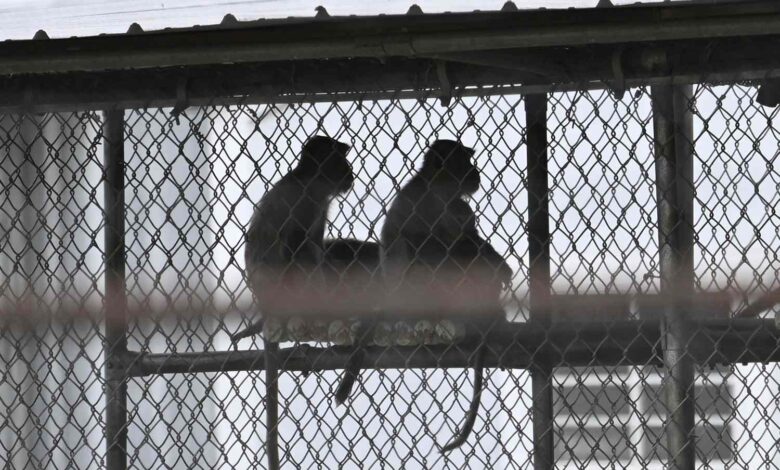
In a sweeping move, the Centers for Disease Control and Prevention (CDC) has directed the immediate termination of all primate research, including infectious disease studies using hundreds of macaque monkeys.
According to a report in Science, published on Friday, Nov. 21, the agency is phasing out primate research experiments, which are widely used in infectious disease research, including HIV prevention. The move affects roughly 200 rhesus and pig-tailed macaques housed at the CDC’s Atlanta facilities
“It’s unprecedented,” Sally Thompson-Iritani, the assistant vice provost overseeing the University of Washington’s animal care program, told the journal. The report confirms that the animals will be either transferred to neighboring animal sanctuaries or euthanized. “It’s a huge loss for the HIV field,” added Deborah Fuller, Ph.D., director of the Washington National Primate Research Center and a HIV researcher.
MLADEN ANTONOV/AFP via Getty
The termination of primate research was communicated to U.S. researchers by Sam Beyda, a former employee of the Department of Government Efficiency (DOGE) who was recently appointed as the CDC’s deputy chief of staff. According to Science’s reporting, an unnamed official said Beyda was relaying the position of Health and Human Services Secretary Robert F. Kennedy Jr., who has made scaling back animal research a key focus of his Make America Healthy Again (MAHA) initiative. The official added that the change to infectious disease research came “ferociously fast.”

In a statement from the U.S. Department of Health and Human Services to PEOPLE, the agency shared, “The CDC is committed to the highest standards of ethical and humane care and to minimizing the use of laboratory animals in accordance with the principles of animal welfare in scientific research known as ‘replacement, reduction, and refinement.”
The statement continues, “As a part of long-standing agency practice and in alignment with the administration’s priorities, CDC regularly evaluates its research project portfolio, including non-human primate studies, and strives to use non-animal research methods whenever feasible, while ensuring the integrity of research that protects public health and safety.”
The spokesperson did not immediately respond to PEOPLE’s request for comment on the expected transition plan for the research animals.
OLIVIER DOULIERY/AFP via Getty
The MAHA Commission, chaired by Kennedy, released a strategy in September with more than 120 initiatives aimed at reversing what it calls “failed policies” driving “America’s childhood chronic-disease epidemic.” Central to that vision is a pivot away from animal-based science toward human-based technologies.
According to Thompson-Iritani, including those housed at the CDC, the National Institutes of Health houses about 7,000 monkeys who now need to be euthanized or transferred.
“We have a responsibility to take care of these animals,” Thompson-Iritani told Science. “That should be included in any road map.”
The move has drawn praise and alarm in equal measure. Animal-welfare advocates have applauded the decision as a meaningful step toward eradicating what they describe as ethically fraught and outdated experiments. But many infectious-disease researchers are sounding the alarm.
Never miss a story — sign up for PEOPLE’s free daily newsletter to stay up-to-date on the best of what PEOPLE has to offer, from celebrity news to compelling human interest stories.
JoAnne Flynn, a renowned tuberculosis researcher, told Scientific American that ending these primate studies risks halting critical work that “just cannot be replaced” easily because, in her words, “things really need to be tested in a system that’s very similar to humans.”
This Article was copied from nypost .com, visit to read more
NOTE: THIS SITE DOES NOT BELONG TO FACEBOOK