
Detectable Wolf DNA in Two-Thirds of Dog Breeds, Including Chihuahuas, Study Reveals

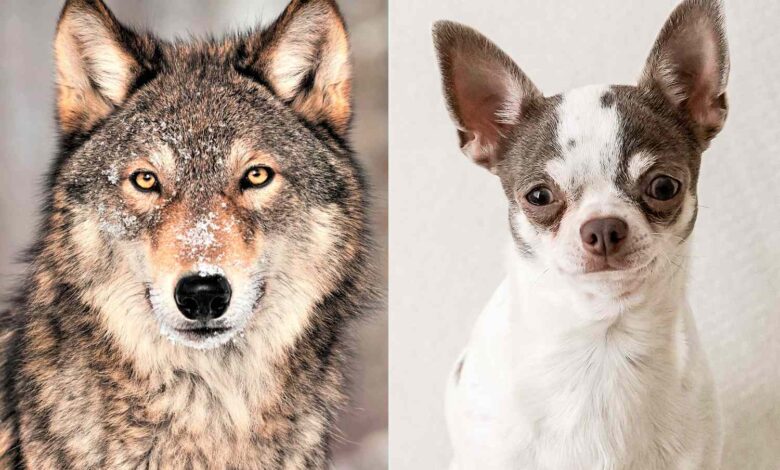
The tiny, fluffy Chihuahua shuffling past you on the street may be part wolf.
According to a new study led by scientists at the American Museum of Natural History and the Smithsonian’s National Museum of Natural History, close to two-thirds of all dog breeds have a detectable amount of wolf DNA.
This wolf ancestry revelation was published in Proceedings of the National Academy of Sciences on Nov. 24.
“Altogether, the majority of dogs today have low, but detectable levels of postdomestication wolf ancestry that has shaped their evolution and conferred unique advantages to their survival in diverse human environments,” reads the study’s introduction.
Per CBS News, the wolf DNA detected in two-thirds of dogs during this study is not genetic material left from when dogs evolved from wolves over 20,000 years ago; instead, scientists have found it’s likely DNA traces from when it was more common for wild wolves and domestic dogs to interbreed several thousand years ago.
Scientists embarked on the study to determine how much wolf DNA is present in modern-day dogs, since it is now rare for wolves and dogs to breed. Their research found that 64 percent of current dog breeds contain traceable wolf DNA from a few thousand years ago. Even Chihuahuas were revealed to be a little wolf, with the study finding that 0.2 percent of the breed’s DNA traces back to wolves.

Getty
Dog breeds with the most wolf DNA include the Grand Anglo-Francais Tricolore hound — which has roughly 5 percent wolf DNA — Salukis, and Afghan hounds. Of course, not all breeds were touched by wolf DNA. Saint Bernards tested negative for wolf DNA, suggesting modern-day Saint Bernards likely had recent ancestors with little contact with wolves.
CBS reported that the study found Arctic sled dogs and hunting dogs were the dog breeds most likely to have wolf ancestry, while terriers and scent hounds were the least likely.
Getty
Never miss a story — sign up for PEOPLE’s free daily newsletter to stay up-to-date on the best of what PEOPLE has to offer, from celebrity news to compelling human interest stories.
The study’s lead author, Audrey Lin, a Gerstner Postdoctoral Scholar in Bioinformatics and Computational Biology at the American Museum of Natural History, told Phys.org that the findings reveal “that dog genomes can ‘tolerate’ wolf DNA up to an unknown level and still remain the dogs we know and love.”
“Most dogs are a little bit wolfy,” she added.
This Article was copied from nypost .com, visit to read more
NOTE: THIS SITE DOES NOT BELONG TO FACEBOOK