Drivers balk at $50K car price tags as sticker shock prompts buyer revolt

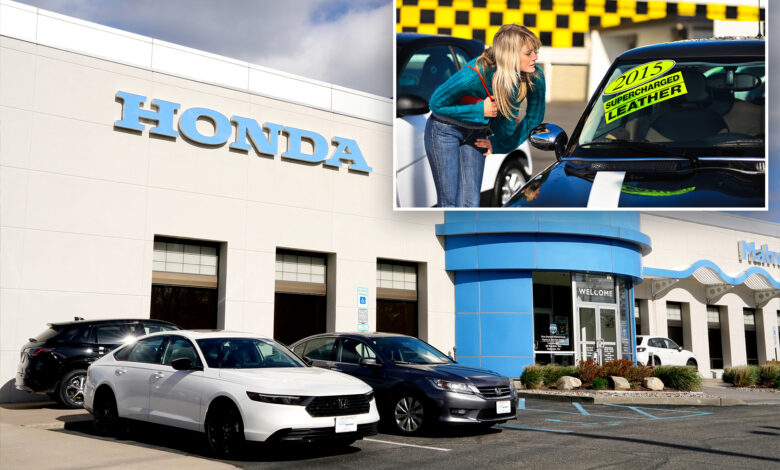
Americans are finally slamming the brakes on car purchases as the cost of a new ride blasts past $50,000 — leading to canceled sales and mounting delinquencies while consumers face ongoing economic uncertainty.
The breaking point came in September, when the average transaction price for a new car crossed $50,080, according to estimates from Kelley Blue Book — a record high after a multiyear run-up that left household budgets stretched to the limit.
Average monthly payments hit $756 in the second quarter, with nearly one in five buyers committed to notes topping $1,000. The typical loan term stretched to 69.8 months, with 22.4% of loan terms pushing into 84-month territory.
Bruising costs are reshaping the showroom.
“People are asking, ‘How can I afford this?’” East Texas dealer Robert Peltier told The Wall Street Journal.
“There are people who are in debt and living paycheck to paycheck.”

While auto tariffs may not have affected the car industry as badly as some feared, consumers are still wary of major purchases as the cost of living goes up and uncertain times lie ahead.
A spring survey by CarEdge found 83% of shoppers would cancel their purchases if payments rose 25%. More than four in 10 would-be buyers have already nixed sales, including high-income people who once shrugged at rising prices.
The fallout is being felt throughout the industry, with used-car retail sales consistently rising over the past year.
Meanwhile, inventory of new vehicles under $30,000 swelled 42% late last year as buyers hunted for cheaper models, according to Cars.com.
More consumers are putting off purchases entirely, citing tighter finances and an uncertain economy.
That hesitation is hitting a market already under pressure. Analysts had expected 2025 to be a banner year as factories returned to full tilt after years of shortages.
Instead, forecasts now call for flat or no growth this year and little improvement in 2026. Automakers enjoyed strong results through the first three quarters — GM’s sales went up 10.5%, Ford’s 7.3% — helped by a pre-deadline rush for electric vehicles before the federal $7,500 EV credit expired in September.
But October’s selling rate was the slowest in more than a year, with November expected to deliver more pain.
Signs of strain are accumulating. Cars are sitting longer on lots. For their part, dealers are scrambling with bigger discounts and offers, which climbed to 7.4% of the average transaction price in September — the highest this year.
Lower-income borrowers are missing payments at levels unseen since the Great Recession that started in late 2007. The overall 60-day delinquency rate climbed to 1.38% in the first quarter — surpassing the 2009 peak — according to data cited by loan servicing company Prodigal.
Subprime delinquencies hit 6.6% in January, a new record. A July report found 73% of drivers with loans or leases feeling regular stress over making payments.
“Other components of the economy are tugging on the consumer,” Ivan Drury of Edmunds.com told The Journal.
That pressure is forcing many shoppers into survival mode. Edmunds data shows buyers taking on longer loans, putting down less cash — the average down payment slipped to $6,020 in the third quarter — and financing more of their purchase just to squeeze into a monthly payment they can manage.
“You can’t really find relief,” Drury said.
New-vehicle margins weakened across several major auto retailers last quarter as customers refused to stomach higher prices.
“Something’s got to give and it’s typically the dealer that will have to put more money on the hood to move the vehicle,” Cox Automotive analyst Erin Keating told The Journal.
In New Rochelle, NY, Chevrolet dealer Michael Sassano said online and in-store traffic has softened. Higher-end shoppers, he said, already bought earlier in the year.
Now he’s seeing cautious buyers who postponed upgrades for years and refuse to take on higher payments.
“More customers just aren’t willing to pull the trigger,” he told The Journal.
“They say, ‘Wow, I’m paying $500 a month now, I don’t want to pay $700’.”
But the pullback isn’t universal. A wealthy slice of consumers is still snapping up trucks and SUVs loaded with creature comforts, propping up the upper end of the market even as the bottom squeezes tight.
“There are going to be a few more alarm bells out there saying: ‘We really are relying on the top 20% of households’” to sustain the market, Keating told The Journal.
NOTE: THIS SITE DOES NOT BELONG TO FACEBOOK