
Lost Toys Museum Started with Doll’s Head Frozen in the Sand (Exclusive)

NEED TO KNOW
- Founded in 2021 by Corinn Flaherty, the Museum of Lost Toys & Curiosities in Massachusetts is home to thousands of objects that washed ashore on a nearby beach
- Flaherty has collected discarded items found during her morning walks for the last 10 years
- She hopes to raise people’s awareness about marine pollution
A Massachusetts museum is proof that one person’s garbage is another’s treasure.
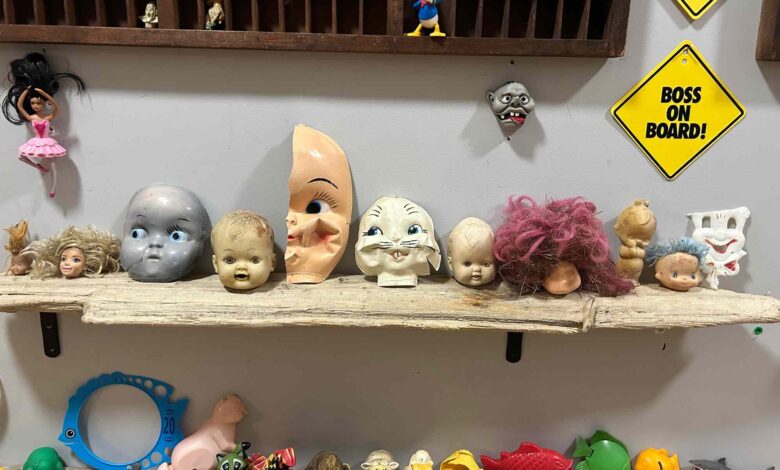
Located on Plum Island, the Museum of Lost Toys & Curiosities houses thousands of objects that were discarded and washed up on a local beach — from Monopoly pieces and cutlery to toy soldiers and doll parts. Through displaying the flotsam, Corinn Flaherty hopes to raise people’s awareness about marine pollution.
“Nobody wants to be slapped on the hand and be like, ‘Stop buying plastic,’ ” she tells PEOPLE. “But I think the visual impact that you feel when you walk into the space stays with you.”
Originally from Long Island, N.Y., the public library director moved to Plum Island in 2011 after a decade in Boston.
Every morning, she started off her days by walking on the beach with her dog and heading north to a jetty at the mouth of the Merrimack River. During one of those walks in 2015, she came across a plastic doll’s head.

Corinn Flaherty
“It was a really cold morning, and it was just this one doll head stuck in the sand,” Flaherty recalls. “And when I tried to get it off, it was literally frozen in the sand.”
“I took it home just out of curiosity,” she adds.
From there, she started collecting other items she found, including straws, plastic cutlery, bottle caps and micro plastics.
“The most common thing I find, oddly enough, are shotgun shells, which usually confuses people,” she says. “But there are people hunting ducks in all of the marshes up and down the river, and all of those spent shells end up floating right down the river and onto our beach.”
Corinn Flaherty
Flaherty says that there was once a shoe industry along the Merrimack Valley in Lawrence and Haverhill, so she’s no stranger to coming across shoe heels that still have the plastic injection mold stuck to the tip.
Other unusual items she’s found include a Merrimack College professor’s name badge and a cloth label with a name and number that turned out to be from someone who had previous run-ins with the law.
“Most of what I find is plastic trash, and I’d say three quarters of what I pick up goes back into my own garbage or recycling,” she says. “And then the gems or things that already have a collection ends up going into a bucket and getting cleaned because they’re dirty.”
Corinn Flaherty
In 2021, Flaherty rented studio space in a building in Amesbury, Mass., that was once a carriage factory, but now serves as the home of the Museum of Lost Toys & Curiosities.
The museum currently occupies three rooms — and comes with an added bonus for visitors: a scavenger hunt.
“There’s four different ones, and you can go through the museum and each scavenger hunt has nine items, and you have to like, find each little item…Anytime people do it, they’re like, ‘Oh my God, I’ve been here before, but I never noticed this,’ ” she says. “It brings people’s attention to things.”
Corinn Flaherty
The museum, which has been featured on local TV station WCVB and The Boston Globe, is open to visitors by appointment only — and Flaherty hopes that additional funding will allow her to have regular open hours and bring in school groups.
What amazes her about the museum is the diversity of people that it draws. “It attracts other collectors, environmentalists, and those just curious to see this collection of stuff that’s all been culled from one little strip of beach,” Flaherty says. “I’ve met really interesting, wonderful people as a result.”
Another highlight for her are the stories she hears from visitors whose personal memories are sparked by the objects, such as a red bird whistle.
“This weekend a man about 70 was visiting and was so excited to tell me he had the same whistle when he was a boy and used to think he could communicate with the birds when he played it. He said he hadn’t thought of that memory probably since he was a kid,” she says. “Everyone who comes through the space inevitably has a reaction like this to something in the collection.”
Corinn Flaherty
Although there’s a tinge of irony and sadness that the objects in the museum are the products of the growing marine pollution problem, the collection has made a difference, at least on a small scale.
Flaherty says that a year after first visiting the museum, a woman who oversees events for her PTA came back and said she’d been inspired stopped buying plastic cutlery for events.
Never miss a story — sign up for PEOPLE’s free daily newsletter to stay up-to-date on the best of what PEOPLE has to offer, from celebrity news to compelling human interest stories.
“I was like, ‘If I had done one thing in my life, I did that!’ ” Flaherty says.
“That’s my goal,” she adds. “No one can avoid plastic. No one’s perfect. We are part of this giant machine, But you can make little tiny changes in your life and actually have a big impact, which is pretty cool.”
This Article was copied from nypost .com, visit to read more
NOTE: THIS SITE DOES NOT BELONG TO FACEBOOK