
Mystery of who built over 900 multi-ton Easter Island statues shocks researchers

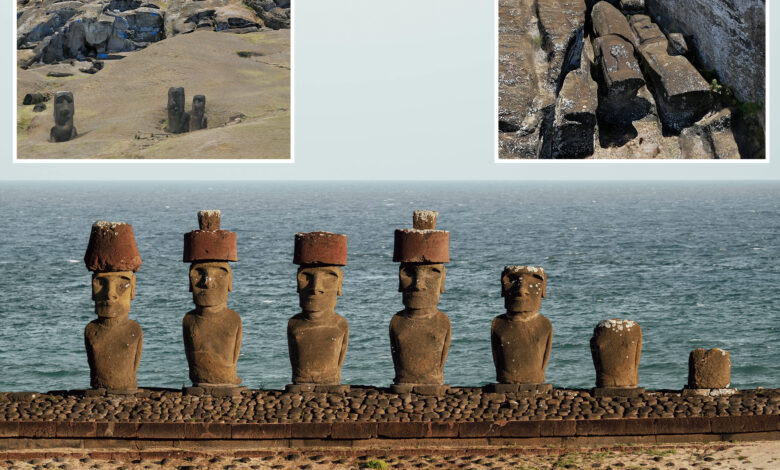
The gargantuan heads of Easter Island may have finally tacked on an artist credit — or several, it turns out.
The over 900 statues on Rapa Nui, the indigenous name for the Chilean territory, had long been thought by researchers to be carved by hundreds of workers in a single chiefdom sometime during the 13th century. However, new research has led scientists to believe that each individual statue — called the moai — was most likely carved by competing clans or families.
It is now estimated that each moai, which weighed up to 80 whopping tons, had as few as four to six people working on it.
Archaeologists have determined 30 separate “workshops” where the statues were made by assessing a fresh 3D model featuring the island’s main moai quarry.
Each workshop appears to have operated by using its own unique carving techniques and production features.
Another piece of evidence pointing to no central management of moai construction is that scientists have determined that the carved statues were transported out of the quarry in several different directions, rather than along one main route.

To create the latest 3D model that enabled these discoveries (the study was documented in the journal PLOS ONE), researchers used a drone to take approximately 22,000 photos of the site, which were then integrated into the all-access digital map.
While the new model shows tops and sides of the area that could not be seen on the ground before, the reasons for the making of the moai — along with why so much time, funds and manpower were invested in their construction — remain shrouded in mystery.
“The quarry is like the archaeological Disneyland,” said Professor Carl Lipo of Binghamton University in a statement. “We see separate workshops that really align to different clan groups that are working intensively in their specific areas.”
“You can really see graphically from the construction that there’s a series of statues being made here, another series of statues here and that they’re lined up next to each other,” Lipo continued.
The recent discovery of the moai’s true builders comes not long after scientists from Binghamton University and the University of Arizona confirmed that the statues were moved by “walking” across Easter Island. They were likely designed to be pulled by some rope in a side-to-side wobbling motion.
“Once you get it moving, it isn’t hard at all — people are pulling with one arm,” Lipo said in a previous report. “It conserves energy, and it moves really quickly. The hard part is getting it rocking in the first place.”
Lipo and his team even tested out the theory by building a 4.35-ton moai replica that 18 people ‘walked’ forward 100 meters (or 328 feet) in 40 minutes.
All this evidence points to the conclusion that the people of Rapa Nui had an individual clan-based, smooth-sailing system to move their iconic statues.
”(This) really connects all the dots between the number of people it takes to move the statues, the number of places, the scale at which the quarrying is happening and then the scale of the communities,” Lipo said.
This Article was copied from nypost .com, visit to read more
NOTE: THIS SITE DOES NOT BELONG TO FACEBOOK