

When John Alan Ambrose and his wife, Vicky, started exploring the idea of owning a place in Italy, they bypassed the widely publicized 1-euro home programs and instead made a more unconventional wager: buying part of an abandoned mansion in a little-known northern Italian city they had never visited.
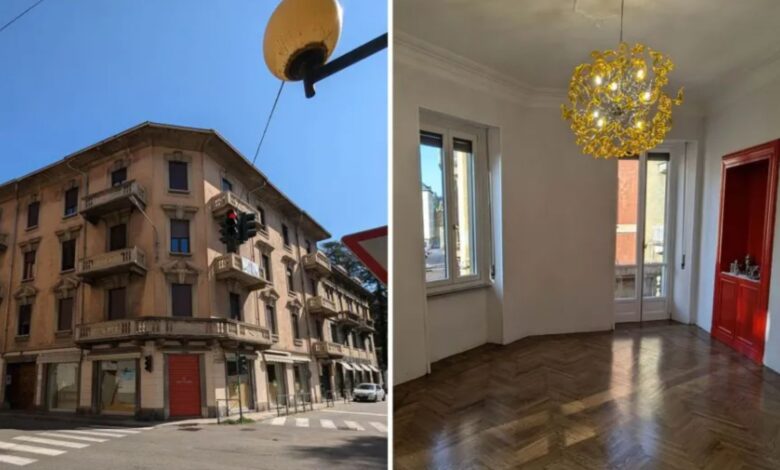
The Houston pair paid about $160,000 in 2022 for a floor of a former palazzo in Biella, a wool-industry hub in the Piedmont region, set against the foothills of the Alps.
The property, a 1930s Liberty-style building once tied to an aristocratic family, had stood empty for years.
Inside, original details remained — towering ceilings, arched windows, wood doors — but much of the interior had fallen into disrepair.
Vicky first encountered Biella while exploring potential cashmere and wool suppliers for a fashion venture after the pandemic.
“On my first trip there, I really liked the vibe of the town,” she told CNN in an interview. She appreciated its modest scale, sense of safety and proximity to airports, lakes and ski areas in the Aosta Valley and around Piedmont.

Real-estate pricing sealed her interest.
“The price of real estate was also very attractive compared to the United States,” she said.
Her husband bought into the vision without setting foot in the city. Vicky’s descriptions — and help from a local friend to navigate Italian regulations — led them to make an offer remotely.
The couple wanted something spacious enough for long stays but simple to leave vacant between visits. In their view, comparable square footage in Houston would have cost several times more.
Their first in-person walkthrough came only after the transaction had closed. The state of the property — from broken tiles scattered across the entry to a detached water heater hanging in the kitchen — made clear that a full overhaul lay ahead. The project ultimately required another roughly $165,000 in renovation costs.
Progress unfolded unevenly. Pandemic-era backlogs slowed contractors, and shifting bids created headaches for owners accustomed to US norms.
“First the language barrier, then the quotes that shifted like seasons, contractors that vanished and appointments blurred into indefinite timelines,” Vicky said.
Some vendors, including their plumber, proved dependable.
Others, she notes, “held our money for nearly a year with multiple excuses and delays.”
John found the lack of detailed written estimates particularly challenging.
“Many Italian tradesmen did not give detailed bids, covering the scope of work, so it made it difficult from afar,” he told CNN. Labor, in theory cheaper than in the US, did not always translate to lower invoices.
“Many suppliers in Biella wanted to overcharge for their services,” he adds.
Regulatory requirements introduced further complications.
Because the apartment sits in Biella’s historic center, even modest updates — such as replacing drafty bathroom windows — required approvals to ensure the building’s exterior appearance remained intact. That included sign-off from the local government as well as the condominium association.
“As these were exterior windows and we are in the historic center, we had to demonstrate that they would not adversely affect the architectural façade of the building,” John said.
To keep the project moving, Vicky made repeated trips to Italy and even took on demolition work herself.
With the help of an American friend, she removed defective tiling and cleared sections of the apartment to prepare for tradespeople.
Gradually, the home took shape: new wiring and plumbing, refinished flooring, updated kitchens and baths and an added bar area. A cramped pipe-filled closet eventually became a guest-room ensuite.
Today, the second-floor unit functions as a multi-season base for the couple, their friends, and their grown son, a Brooklyn musician.
From Biella they can reach ski slopes, vineyard towns, alpine trails or the Italian Riviera within short drives. They’ve grown fond of their routines — morning cappuccinos in the town piazza, visits to the Duomo, tram rides to the medieval quarter and winter weekends on the slopes fueled by bombardinos.
“You feel as if you are in another town with quaint bistros and bars, yet it’s only a few blocks away,” John said.
Local residents often express surprise that Americans would select Biella over Italy’s better-known tourist centers.
“I think many of the locals don’t realize what a great place it is and that everything is available right out their back door,” Vicky said.
The couple has lived abroad before and kept a long-time ski home in Canada. Beaches held less appeal.
“Vicky can spend over 100 days a year on the slopes,” John said. “But will go stir-crazy after three weeks on a beach.”
What they never considered, they say, were the 1-euro houses that have drawn global attention over the years.
“Generally, you get what you pay for, and when it sounds too good to be true it likely is,” John said.
The slower pace of Italian life — midday shop closures, quiet Mondays — still requires adjustment.
“That is our problem as Americans,” he admits. “Unlike Italians, we find it hard to slow down or relax.”
NOTE: THIS SITE DOES NOT BELONG TO FACEBOOK