Trump Ramps Up Attacks on Women in Media, From ‘Quiet Piggy’ to ‘Ugly, Both Inside and Out’

NEED TO KNOW
- President Donald Trump has had several tense encounters with the White House press corps in recent weeks, particularly with female reporters
- After going viral for calling one reporter a “piggy,” his insults continued, with him most recently describing a New York Times journalist as “ugly, both inside and out”
- The incidents fall in line with Trump’s long history of contention with female reporters, which dates back to even before his first presidential campaign
President Donald Trump has been having a particularly tense time with the White House press corps as he navigates a number of sensitive issues — chief among them, his position on the release of the Epstein files.
Though Trump has long been known, and even cheered on by some supporters, for his name-calling against political rivals (Crooked Hillary, Sleepy Joe, Governor Newscum, Kamabla and Marjorie Traitor Greene), his attacks against members of the media have grown increasingly pointed and distracting.
Run-of-the-mill press conferences and casual Q&As with reporters have turned harsh, and published stories have been picked apart. Throughout the chaos, it’s the women of the White House press corps who have borne the brunt of his ire.
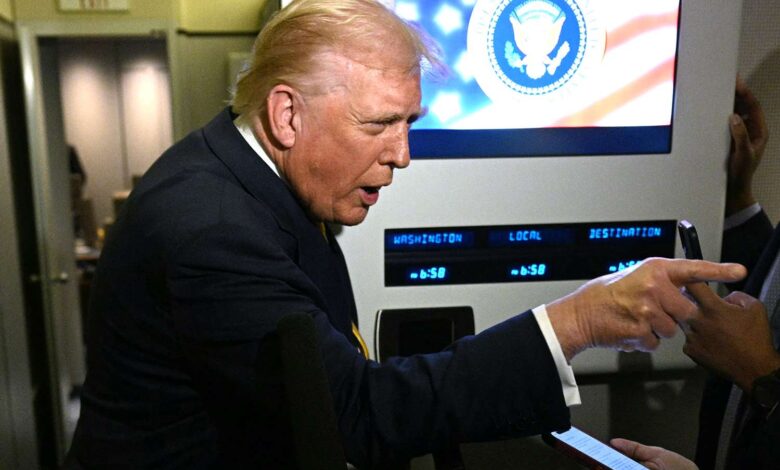
The first recent incident that made major headlines happened aboard Air Force One on Friday, Nov. 14. While Trump, 79, was taking questions from a group of reporters, Bloomberg’s Catherine Lucey began to ask if there was anything “incriminating” in the Epstein emails.
The president responded by pointing his finger in her face and snapping, “Quiet. Quiet, Piggy.”
The insult has been a favorite of Trump’s throughout the years, though that made it no less shocking to hear from the mouth of a president.

In a statement shared with PEOPLE, a White House official defended Trump’s comments, claiming, “[Lucey] behaved in an inappropriate and unprofessional way towards her colleagues on the plane.”
“If you’re going to give it, you have to be able to take.”
The official did not provide any clarity on what made Lucey’s behavior improper, though her prominent colleague in the White House press corps, CNN’s Kaitlan Collins, jumped to Lucey’s defense, saying she does “a great job.”
White House press secretary Karoline Leavitt also defended the “piggy” comment when asked about it in a press conference days later, chalking it up to evidence of Trump’s candid nature.
“He calls out fake news when he sees it. He gets frustrated with reporters when you lie about him, when you spread fake news about him and his administration,” Leavitt, 28, said. “But he also is the most transparent president in history, and he gives all of you in this room, as you all know, unprecedented access.”
“And so I think the president being frank and open and honest to your faces, rather than hiding behind your backs, is frankly a lot more respectful than what you saw in the last administration,” she continued. “I think everyone in this room should appreciate the frankness and the openness that you get from President Trump on a near-daily basis.”
Anna Moneymaker/Getty
Two days after the “piggy” comment, as Trump and the press corps returned from their weekend trip to his Mar-a-Lago resort in Florida, he snapped again while answering a question about Tucker Carlson‘s recent interview with far-right podcaster Nick Fuentes.
“Well, I found him to be good. I mean, he’s said good things about me over the years. He’s, I think he’s good,” he said, referring to Carlson. “We’ve had some good interviews. I did an interview with him where we had 300 million hits.”
When a woman jumped in to ask a follow-up, the president paused with an irritated expression. “Will you let me finish my statement? You are the worst.”
“You’re with Bloomberg, right?” he continued. “You are the worst. I don’t know why they even have you.”
The camera did not show which reporter he was speaking to, making it unclear whether he was attacking Lucey again or addressing someone else.
Trump continued his combative streak during an Oval Office press conference with Saudi Arabian Crown Prince Mohammed bin Salman on Nov. 18. Similar to Lucey a few days earlier, ABC News’ Mary Bruce was attempting to ask a question about Epstein when the president made an example out of her.
“You know, it’s not the question that I mind. It’s your attitude,” he told Bruce. “I think you are a terrible reporter. It’s the way you ask these questions…”
“You’re a terrible person and a terrible reporter,” he said at another point in his response. “As far as the Epstein files, I have nothing to do with Jeffrey Epstein. I threw him out of my club many years ago because I thought he was a sick pervert.”
“People are wise to your hoax,” Trump claimed later in the rant, followed by an apparent threat toward her employer: “I think the license should be taken away from ABC because your news is so fake and is so wrong. And we have a great commissioner, a chairman, who should look at that.”
During his lengthy responses to Bruce in the press conference, Trump also told her that she “ought to go back and learn how to be a reporter” before saying that he’s done taking her questions.
Then, on Wednesday, Nov. 26, Trump took to his Truth Social page to lash out at The New York Times and its White House correspondent Katie Rogers, seemingly referencing a story that Rogers contributed to, which implied that he was facing the “realities of aging in office.”
The story also referenced a viral moment where Trump appeared to doze off during an official event, which he has since denied.
“The Creeps at the Failing New York Times are at it again,” Trump wrote. “The writer of the story, Katie Rogers, who is assigned to write only bad things about me, is a third rate reporter who is ugly, both inside and out.”
He referred to Rogers’ story as a “hit piece” and called the Times an “ENEMY OF THE PEOPLE.”
Steven Hirsch-Pool/Getty; Diane Rusignola
The New York Times reacted to the president’s insults in a statement to PEOPLE later the same day, saying, “The Times’s reporting is accurate and built on firsthand reporting of the facts. Name-calling and personal insults don’t change that, nor will our journalists hesitate to cover this administration in the face of intimidation tactics like this.”
The Times‘ statement continued: “Expert and thorough reporters like Katie Rogers exemplify how an independent and free press helps the American people better understand their government and its leaders.”
The White House, meanwhile, told PEOPLE in a statement: “President Trump has never been politically correct, never holds back, and in large part, the American people re-elected him for his transparency.”
“This has nothing to do with gender,” the White House spokesperson continued, adding, “it has everything to do with the fact that the President’s and the public’s trust in the media is at all time lows.”
Samuel Corum/Getty
Trump ire for the press is nothing new — his beloved “fake news” catchphrase is nearly a decade old at this point. However, these recent encounters continue a disturbing pattern in the president’s behavior towards female reporters in particular.
It began even before he was in office, during the 2016 Republican primaries. After Megyn Kelly moderated a primary debate and opened by asking Trump about his past comments towards women, she became an easy target.
“I have zero respect for Megyn Kelly,” Trump said in an interview with Fox News, Kelly’s outlet at the time. “I don’t think she is very good at what she does. She’s highly overrated.”
He also implied that she was menstruating while moderating the debate in another now-infamous quote: “There was blood coming out of her eyes, blood coming out of her wherever,” he told CNN.
Never miss a story — sign up for PEOPLE’s free daily newsletter to stay up-to-date on the best of what PEOPLE has to offer, from celebrity news to compelling human interest stories.
In response to Trump’s attacks on Kelly, Elisa Lees Munoz, the executive director of the International Women’s Media Foundation, told The Independent, “We know that he does not discriminate on gender with regards to his criticism and his attacks, but we have particularly noticed the way that he attacks female journalists.”
“It is a very gendered attack, which really demonstrates some misogynistic tendencies that we see online and in the streets every day,” she added. “It is really designed to shut them up, to try to get them to stop working, to belittle, to humiliate.”
MANDEL NGAN/AFP via Getty
During his first presidential term, Trump had three bitter exchanges with Black female journalists that went viral over the course of just one month: November 2018.
It was notable, Northwestern journalism Professor Ava Thompson Greenwell, Ph.D, told The Independent, because of how few Black women are part of the White House press corps.
“When he goes after Black women because their numbers are so few, it just stands out more,” she said.
Two of the incidents even happened during the same press gaggle, on Nov. 9. The president began by ranting about CNN contributor April Ryan, who was, at the time, a White House correspondent for American Urban Radio Networks.
“You talk about somebody that’s a loser,” Trump said of Ryan. “She doesn’t know what the hell she’s doing.”
Later in the briefing, he scolded CNN’s Abby Phillip for asking a question about special counsel Robert Mueller, who was, at the time, overseeing an investigation into Russian interference in the 2016 election.
“What a stupid question that is. What a stupid question,” he said to Phillip. “But I watch you a lot, you ask a lot of stupid questions.”
Following the encounter, Phillip addressed Trump’s insults on CNN, saying, “It’s part of a pattern and it is a really clear pattern that’s been going on for years now. He seems to not be tolerant of taking difficult questions, particularly from women.”
Another favorite target of Trump’s has been PBS’ Yamiche Alcindor, also a Black woman, whom he accused of racism in November 2018 for asking him to consider whether calling himself a “nationalist” during his presidential campaign might embolden White nationalism.
Two years later, at the height of the COVID era, Trump said Alcindor was being “threatening” with her line of questioning about pandemic response.
“It’s always getcha, getcha… And you know what? That’s why nobody trusts the media anymore,” the president said. When Alcindor attempted to restate her question, he interrupted again.
“Excuse me. You didn’t hear me. That’s why you used to work for the Times and now you work for someone else,” he said. “Look, let me tell you something: Be nice… Don’t be threatening. Be nice.”
Thompson Greenwell said that Trump’s interactions with reporters, particularly female reporters, could be classified as more than just insults or micro-aggressions.
“What he does is what we would call a micro-assault,” she explained. “It’s not subtle at all. It’s direct, it’s in your face, it’s a tongue lashing, it’s meant to cause harm. And that’s the definition of a micro-assault.”
This Article was copied from nypost .com, visit to read more
NOTE: THIS SITE DOES NOT BELONG TO FACEBOOK